- info@moretec-inc.com
- |
- CN
- |
- JP
In aerospace systems, vacuum furnaces, semiconductor equipment, and high precision automation, sealing performance cannot be treated as a standard catalog item. Once a rotating vacuum interface must operate under elevated temperature, reactive gases, demanding load conditions, or several thousand rpm, the design margin of a standard solution can quickly become insufficient. Moretec focuses on custom ferrofluid sealing units engineered for vacuum, pressure, and contamination control in applications where reliability, cleanliness, and long term stability are critical.
Engineering a custom ferrofluid seal begins with defining the actual operating envelope. Moretec’s current selection guidance emphasizes that vacuum level, rotational speed, torque, operating temperature, shaft type, flange compatibility, and environmental factors such as reactive gases should all be reviewed before a feedthrough is specified. The same guidance lists typical ranges such as leak performance below 1×10⁻⁹ std cc/sec He, vacuum capability down to 10⁻⁹ Torr for UHV applications, rotational speed up to 5000+ RPM, standard operating temperature around 0–80°C, and solid or hollow shaft configurations depending on the process interface.
Temperature management is one of the first design constraints in a custom ferrofluid seal. At elevated temperature, ferrofluid stability, carrier liquid volatility, heat dissipation, and magnetic circuit reliability all become more sensitive. Moretec’s public guidance identifies operating temperature as a primary specification item and notes that water cooling may be required for high speed or high heat applications. Its product range also includes water cooled feedthrough variants for demanding environments. Rather than presenting temperature capability as a single universal number, the stronger engineering approach is to match the cooling method, ferrofluid chemistry, and seal structure to the actual thermal load of the application.
For this reason, custom thermal design should focus on keeping the ferrofluid within an acceptable operating range through housing design, magnetic circuit design, and cooling strategy. In practical terms, this may include water cooled housings, changes in seal geometry, and selection of a ferrofluid formulation with appropriate temperature stability for the process environment.
Reactive gas service requires more than a standard vacuum seal. Moretec’s current selection guidance states that reactive gas environments may require perfluorinated options for chemical stability, and its custom seal materials describe corrosion resistant solutions for harsh chemical or reactive gas environments. Moretec also presents reactive gas seal examples for applications such as MOCVD, LPCVD, PECVD, and designs using aggressive cleaning agents.
A more defensible way to present this capability is not to promise one universal material set, but to state that seal materials and ferrofluid chemistry should be selected according to the gas environment, vacuum level, temperature, and maintenance requirements.
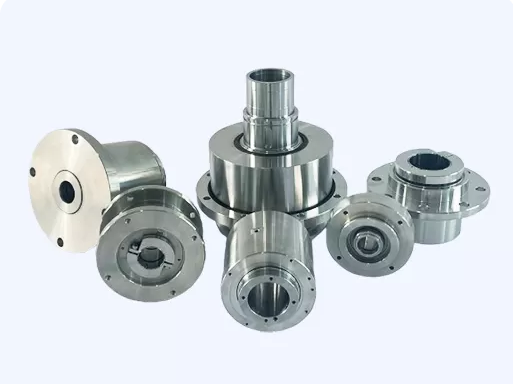
The geometry of the feedthrough is often dictated by the surrounding machine. Moretec publicly offers solid shaft, hollow shaft, and custom ferrofluid feedthroughs, and its selection guide states that hollow shaft configurations are used when gas or electrical passthrough is required. Its custom seal page also states that the company can manufacture solutions for shaft diameters from 4 mm to 1000 mm and optimize the design based on customer drawings.
That makes structural customization one of the most important parts of the design process. In some systems, a solid shaft design may be preferred for stiffness and straightforward rotary transmission. In others, a hollow shaft layout may be necessary to accommodate process gas delivery, wiring, or other functional routing through the center of the rotating interface.
Custom ferrofluid seals are not defined by sealing performance alone. Mechanical load, shaft dynamics, torque, and bearing life all influence long term reliability. Moretec’s design materials state that customer specific operating conditions such as shaft diameter, rotational speed, working temperature, pressure range, and gas type are part of the compatibility review, and they also state that magnetic field analysis and thermodynamic calculations are used to optimize bearing selection, ferrofluid formulation, and seal structure design.
This is the right level of engineering language for a public article because it shows that the seal unit is treated as an integrated mechanical and magnetic system. Instead of claiming a specific bearing precision grade or load class in general marketing copy, it is more credible to say that bearing selection should be engineered according to radial load, axial load, rotational speed, torque, and required service life.
Moretec’s public specification guidance lists maximum rotational speed up to 5000+ RPM, while also noting that heat generation and torque must be considered together with speed. Its custom seal pages further position these products for vacuum, pressure, and contamination control applications rather than vacuum only service. That means a custom design discussion should focus on how the seal will balance magnetic retention, fluid stability, drag torque, thermal load, and differential pressure in the user’s real operating window.
For public facing technical content, it is better to avoid unsupported claims about universal pressure ratings or extreme speed thresholds. A stronger formulation is that custom ferrofluid sealing units can be engineered for several thousand rpm operation and for applications requiring vacuum integrity, pressure resistance, or reactive gas compatibility, provided that the final configuration is matched to the actual shaft size, fluid type, thermal conditions, and process environment. That position is consistent with Moretec’s current public product and selection materials.
A custom ferrofluid seal should be specified as an engineered subsystem, not as a generic replacement part. In demanding sectors such as aerospace, semiconductor manufacturing, vacuum furnace equipment, and high precision motion systems, the correct solution depends on a combination of vacuum level, temperature, speed, load, shaft architecture, gas chemistry, and integration requirements. Moretec’s public materials position its custom ferrofluid sealing units around exactly these variables, with capabilities that include custom sizing, solid or hollow shaft formats, corrosion conscious material options, water cooled configurations, and application specific ferrofluid selection.
Start Your Custom Design Discussion
If your application cannot be solved by a standard rotary feedthrough, Moretec’s Japan headquartered engineering team can review your drawings, operating conditions, and environmental requirements to discuss a custom ferrofluid sealing solution. The company profile states that Moretec was founded in Tokyo, Japan, and its public custom seal materials explicitly invite customers to collaborate with the engineering team based on technical drawings and exact application requirements.