- info@moretec-inc.com
- |
- CN
- |
- JP
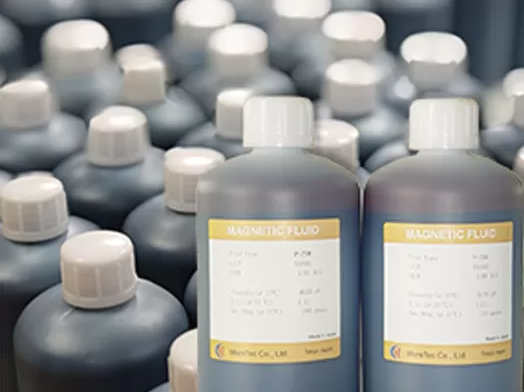
In the pursuit of acoustic performance, engineers must constantly manage two critical challenges: heat buildup and resonance control. As voice coils become more compact and power demands continue to rise, especially in automotive and professional audio applications, conventional air filled magnetic gaps can limit both thermal stability and acoustic consistency. Moretec provides a specialized range of audio ferrofluids designed to support heat transfer, mechanical damping, and stable voice coil behavior in demanding loudspeaker systems.
One of the most important challenges in loudspeaker design is managing voice coil temperature under sustained power. Audio ferrofluid replaces the air in the magnetic gap and improves heat transfer from the voice coil to the surrounding magnetic structure. Publicly available industry materials describe audio ferrofluid as roughly five times more thermally conductive than the air it displaces, while Moretec states that its audio ferrofluid significantly improves thermal conductivity, reduces voice coil temperature, and helps minimize power compression.
By improving thermal dissipation, ferrofluid helps maintain more stable electrical resistance during operation. This supports more consistent sound pressure output and improved power handling during prolonged use.
Audio ferrofluid also provides mechanical damping in the magnetic gap. Moretec’s public materials state that the viscosity of the fluid helps smooth resonance peaks, improve dynamic linearity, and flatten the frequency response. Ferrotec’s audio documentation similarly explains that damping is proportional to ferrofluid viscosity, which is why different formulations are selected for different driver types and response targets.
For engineers developing tweeters, compression drivers, or other precision transducers, the correct fluid selection can help refine resonance behavior and reduce unwanted distortion. Moretec also states that audio ferrofluid can reduce both dynamic and harmonic distortion when properly matched to the speaker design.
Beyond cooling and damping, audio ferrofluid can help stabilize the voice coil within the magnetic gap. Moretec describes this as a liquid O ring effect that helps keep the voice coil centered, reducing misalignment and friction related damage. Public technical references from the audio ferrofluid industry also describe a radial restoring or centering force generated within the gap, which can contribute to more stable coil motion.
This centering effect can support improved mechanical stability and cleaner driver behavior, particularly in applications where precision and long term consistency are important.
Not all loudspeaker systems require the same ferrofluid characteristics. Moretec offers both standard and custom audio ferrofluid models for consumer, professional, and OEM applications. Its public product materials describe viscosity ranges up to 5000 cP and model families tailored to different magnetic field strengths, damping requirements, and acoustic goals. Moretec also offers custom formulations for specialized speaker designs that require optimized viscosity and magnetic properties.
This flexibility is important because tweeters, compression drivers, and other transducers often require different balances of damping, thermal transfer, and magnetic retention.
For speaker manufacturers and acoustic engineers, audio ferrofluid is a practical engineering tool for improving thermal management, damping control, and voice coil stability at the same time. When properly selected for the driver structure and operating conditions, it can help improve power handling, smooth frequency response, reduce distortion, and support more consistent long term performance.
Technical Inquiry
If you are evaluating ferrofluid for a new speaker platform or an existing driver design, Moretec provides standard and custom audio ferrofluid solutions for a wide range of acoustic applications. Contact Moretec to request technical specifications or discuss formulation options for your specific driver profile.