- info@moretec-inc.com
- |
- CN
- |
- JP
Metal mesh components used in cryopump applications must be evaluated as part of the complete adsorbent, cold-surface, and attachment design. Mesh count alone cannot define the fit, cleanliness, mechanical stability, or vacuum performance of the finished component.
In some cryopump designs, metal mesh can retain adsorbent, provide a gas-permeable support structure, and contribute to thermal contact with the cold surface.
Its value depends on geometry, material, cleanliness, attachment, and compatibility with the pump design—not mesh count alone.
Mesh count may describe the nominal number of openings, but it does not independently define the actual opening size, open area, or mechanical behavior of the finished component.
A supplier drawing and inspection plan should define the finished component after forming, joining, and cleaning. Raw woven-wire data cannot predict fit or performance inside the cryopanel.
The cryopump manufacturer remains responsible for validating pumping speed, capacity, thermal performance, and regeneration behavior in the complete pump assembly.
The component specification should define:
Required open area and available surface area
Wire diameter, opening size, and weave or expanded-metal geometry
Material grade, cryogenic mechanical properties, thermal-expansion compatibility, magnetic restrictions, corrosion resistance, and vacuum outgassing requirements
Finished shape, seam, edge, and attachment method
Adsorbent retention and acceptable particle release
Thermal-cycle range, vacuum cleaning, and packaging level
Critical finished dimensions and allowable geometric distortion
Required traceability, inspection level, and acceptance criteria
Whether the mesh is intended primarily for adsorbent retention, gas access, mechanical support, or thermal contact
Metal mesh components intended for cryopump applications should be evaluated as finished formed assemblies rather than only as raw woven material.
Moretec can review customer drawings and manufacturing requirements for formed metal mesh components intended for cryopump applications.
Confirm which dimensions are measured before and after joining and how spring-back is controlled.
The drawing should also state whether dimensions apply in the free condition, restrained condition, or final installed condition.
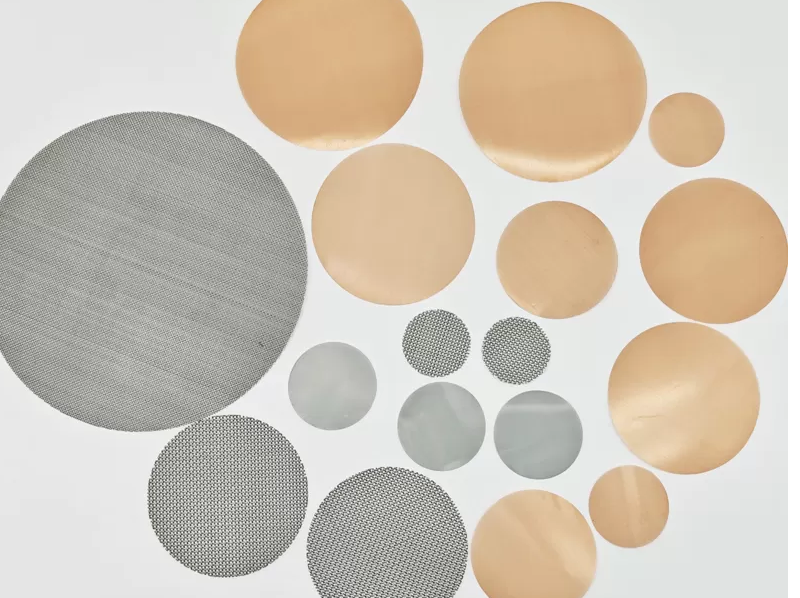
A more open structure can reduce flow restriction but may retain adsorbent less effectively or deform during handling.
Finer wire and smaller openings may increase available surface area, but they can also reduce gas conductance, make cleaning more difficult, and increase the risk of deformation or damage.
Select geometry from the pump and adsorbent design. Prototype the most demanding formed section and inspect opening distortion at seams, corners, and attachment points.
The evaluation should consider:
Adsorbent particle size and retention requirements
Required gas access to the adsorbent
Handling and assembly loads
Forming depth and bend radius
Edge stability and loose-wire risk
Distortion caused by welding, brazing, or mechanical fastening
Where the finished component includes multiple mesh layers, the relative orientation and overlap of the layers should also be defined.
The thermal performance of the adsorbent assembly may depend partly on the contact between the mesh, adsorbent, and cold surface.
Loose interfaces, limited contact area, poor joint quality, or oxide and contaminant layers can add thermal resistance.
Define the attachment pressure, weld or braze method, or mechanical interface that represents the production design.
The specification should also identify the intended primary heat-transfer path and whether the mesh is required to contribute directly to thermal conduction.
Thermal cycling can relax joints or change shape. Inspect after repeated cycles for distortion, cracking, detached wires, and adsorbent migration.
Where thermal-cycle testing is required, the customer and supplier should agree on:
The representative test assembly
Minimum and maximum temperatures
Number of cycles
Heating and cooling rates
Inspection and acceptance criteria
The party responsible for testing
Thermal-cycle testing should not be assumed to be a standard shipment inspection unless it is specifically included in the drawing, specification, or purchase order.
| Control | Question to answer |
|---|---|
| Raw material | Is material-grade, heat, or batch traceability required? |
| Forming lubricant | How is residue removed and verified? |
| Joining | Are flux residue, oxide, discoloration, or loose particles permitted? |
| Final cleaning | Which cleaning chemistry, water quality, rinsing standard, and drying method apply? |
| Packaging | What clean barrier, handling environment, and packaging label are required? |
| Surface condition | Are stains, embedded particles, burrs, broken wires, or handling marks permitted? |
| Outgassing control | Is process qualification or vacuum-bake validation required? |
The customer and supplier should agree on a cleanliness-verification method, which may include gravimetric residue testing, particle inspection, wipe testing, or qualification of the complete cleaning process.
A generic “ultrasonic cleaned” statement does not establish the final contamination limit.
The specification should define the acceptable result, not only the name of the cleaning process.
Cleaning requirements should also consider whether the completed part contains seams, folded edges, or enclosed regions where residue or rinse water could remain.
Define sampling for wire and opening geometry, open area, finished dimensions, seam strength, visual defects, and cleanliness.
If the part is difficult to measure after forming, approve fixtures or optical methods during design review.
Inspection requirements may include:
Material grade and batch verification
Wire diameter and opening measurement
Open-area verification
Finished-part dimensions
Form and profile inspection
Seam or joint integrity
Burrs, broken wires, and loose-particle inspection
Cleanliness verification
Packaging and labeling inspection
Link each shipment to material certificates, process lot, inspection results, and packaging label.
Retained samples or photographs help analyze later pump-performance variation.
Where full dimensional inspection is impractical, the drawing should identify critical characteristics and define an agreed sampling plan.
Any requirement for destructive seam-strength testing, thermal cycling, or vacuum testing should be stated separately from routine visual and dimensional inspection.
No. Include wire diameter, opening size, material, weave, open area, finished shape, joining method, cleanliness, and tolerances.
Mesh count alone does not define the finished opening, open area, mechanical strength, or formed-part geometry.
Residues and particles can increase outgassing, contaminate the vacuum system, or interfere with the adsorbent and thermal interfaces.
Cleaning agents, forming lubricants, joining residue, and loose wire fragments should therefore be controlled through both process requirements and final acceptance criteria.
Yes, when thermal cycling may change the geometry, joints, or adsorbent-retention performance.
Use a representative assembly and defined acceptance criteria.
The temperature range, number of cycles, test fixture, and responsible party should be agreed before testing.
Provide a 2D drawing, material and cleanliness specification, annual volume, attachment method, and inspection or documentation requirements.
Also provide:
The mesh function within the pump
Adsorbent type and particle size, where relevant
Finished installation condition
Critical dimensions and tolerances
Joining or fastening requirements
Thermal-cycle requirements
Prototype quantity and target delivery schedule
Required material certificates and inspection record
Moretec can review customer drawings covering mesh geometry, forming, joining, cleaning, inspection, and packaging requirements. Manufacturing feasibility should be evaluated against the finished-part specification and the actual installation condition.
A controlled finished-part specification protects fit, thermal contact, and vacuum cleanliness better than a raw-mesh designation alone.
Final cryopump performance—including pumping speed, capacity, thermal response, and regeneration behavior—should be validated by the pump manufacturer using the complete production-intent assembly.