- info@moretec-inc.com
- |
- CN
- |
- JP
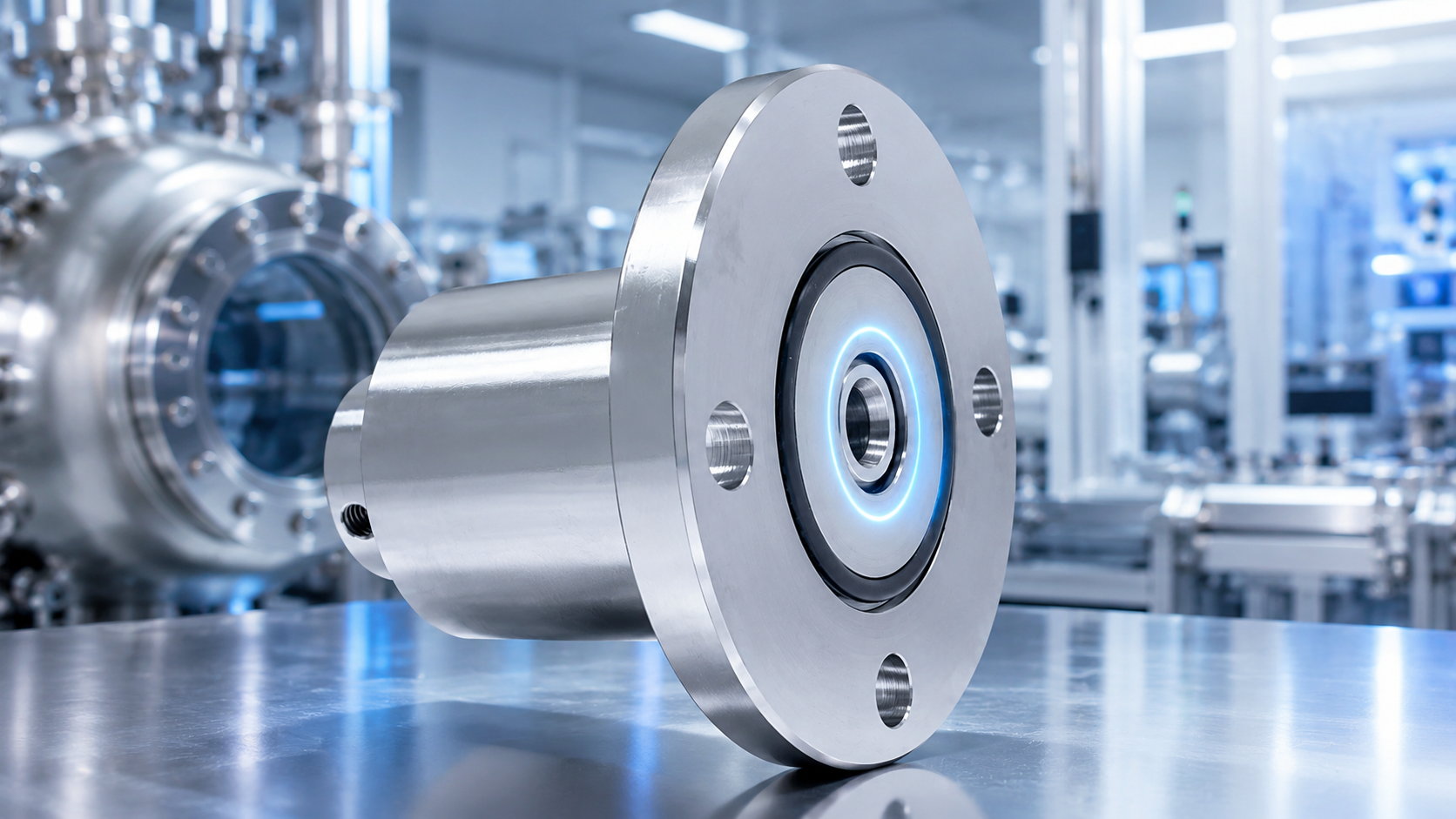
Rotary motion inside a vacuum environment creates unique engineering challenges. Equipment must transfer mechanical movement through a vacuum chamber wall while maintaining vacuum stability, preventing leakage, and minimizing contamination.
A rotary vacuum feedthrough provides an effective solution by transmitting rotational motion between atmospheric and vacuum environments while maintaining reliable sealing performance.
In precision vacuum systems, conventional contact-type sealing methods may experience friction, wear, leakage, and increased maintenance during long-term operation. A ferrofluid-based rotary vacuum feedthrough uses magnetically retained ferrofluid to form a stable sealing barrier around the rotating shaft, helping reduce sealing-interface wear and particle generation.
Moretec provides standard and customized rotary vacuum feedthrough solutions for semiconductor equipment, vacuum coating systems, industrial vacuum equipment, and other precision applications.
Unlike static vacuum systems, rotary equipment must maintain vacuum isolation while continuously transmitting mechanical motion.
This creates several technical challenges:
Vacuum leakage: Even small leaks may affect process stability and vacuum performance.
Mechanical wear: Continuous contact between conventional sealing surfaces can shorten service life.
Particle generation: Wear particles may create contamination risks in clean environments.
Heat generation: Rotation, bearings, and sealing resistance can increase operating temperature.
Mechanical loading: Radial, axial, and moment loads can affect shaft and bearing life.
Maintenance requirements: Frequent replacement of sealing components increases equipment downtime.
Traditional vacuum shaft seals often rely on direct contact between sealing elements and the rotating shaft. Although suitable for some applications, continuous operation may gradually increase friction and wear.
A ferrofluid seal uses a magnetic field to retain ferrofluid in the sealing gaps around the shaft. Multiple liquid sealing stages form a stable barrier between vacuum and atmosphere while allowing the shaft to rotate.
A ferrofluid rotary vacuum feedthrough is particularly useful where stable vacuum performance, clean operation, and reliable rotation are required.
Key advantages include:
Ferrofluid is held in place by a precisely designed magnetic circuit and forms multiple sealing stages around the rotating shaft.
This structure provides reliable isolation between the vacuum chamber and atmospheric side.
The primary sealing interface does not rely on conventional solid-to-solid rubbing contact.
This helps reduce wear-particle generation and makes ferrofluid feedthroughs suitable for semiconductor, coating, and other clean vacuum applications.
Compared with conventional contact-type seals, ferrofluid sealing reduces mechanical wear at the sealing interface.
This can help extend maintenance intervals when the feedthrough is correctly selected for the operating conditions.
Ferrofluid sealing provides stable rotary motion with relatively low sealing resistance.
Actual starting and running torque depend on shaft diameter, ferrofluid, bearings, rotation speed, temperature, and overall feedthrough design.
When properly selected according to speed, load, temperature, process environment, and cooling conditions, ferrofluid feedthroughs can support equipment requiring extended or continuous operation.
A rotary vacuum feedthrough should be selected according to the complete operating environment, not only by dimensions.
| Selection Factor | Why It Matters |
|---|---|
| Vacuum level | Determines required sealing performance |
| Pressure differential | Influences sealing-stage design |
| Rotation speed | Affects heat, torque, and service life |
| Radial and axial load | Influences shaft and bearing design |
| Shaft configuration | Determines mechanical integration |
| Operating temperature | Affects ferrofluid and bearing performance |
| Process gas | Requires material and ferrofluid compatibility |
| Duty cycle | Influences thermal design and service life |
| Mounting interface | Determines compatibility with equipment |
| Cooling requirement | May be required for demanding applications |
These parameters should be evaluated together.
For example, a low-speed feedthrough carrying a high radial load may require a different bearing arrangement from a high-speed feedthrough with minimal external loading.
Vacuum level is one of the first parameters to consider when selecting a rotary feedthrough vacuum solution.
Depending on the application, equipment may operate under low, high, or ultra-high vacuum conditions.
Engineers should evaluate:
Target vacuum level
Maximum allowable leak rate
Pressure on the atmospheric side
Maximum pressure differential
Process gas
Vacuum level and pressure differential are not the same.
Even when the vacuum chamber operates at very low absolute pressure, the feedthrough may still need to withstand approximately one atmosphere of differential pressure.
The magnetic circuit and ferrofluid sealing stages must therefore be designed according to the actual pressure conditions.
Rotation speed directly influences feedthrough performance.
Heat may be generated by:
Ferrofluid viscous drag
Bearing friction
External mechanical loads
Continuous high-speed operation
Higher temperatures can affect ferrofluid properties, bearing life, and overall reliability.
For demanding operating conditions, a water-cooled design may be required.
Important information includes:
Normal rotation speed
Maximum rotation speed
Continuous or intermittent operation
Ambient temperature
Vacuum-side temperature
External heat sources
Cooling conditions
The theoretical maximum speed of a feedthrough should not automatically be considered the recommended continuous operating speed under every load condition.
External mechanical loads can significantly influence rotary feedthrough life.
Typical loads include:
Radial load
Axial load
Belt tension
Gear load
Coupling load
Moment load
These forces are transferred through the shaft to the bearings.
Excessive load may shorten bearing life even when the ferrofluid sealing section continues to maintain vacuum.
For customized applications, Moretec recommends providing radial and axial loads, load direction, load application point, and shaft-side layout.
This information helps determine the appropriate shaft diameter and bearing arrangement.
Different equipment structures require different shaft configurations.
A solid shaft rotary vacuum feedthrough is commonly used when the main requirement is mechanical rotary transmission.
Typical applications include:
Wafer or substrate rotation
Vacuum coating systems
Rotary fixtures
Vacuum furnaces
Precision positioning equipment
A hollow shaft rotary vacuum feedthrough provides a central through-bore.
Depending on equipment design, the bore may accommodate:
Customer shafts
Tubes
Cables
Sensors
Electrical connections
Other internal components
Hollow shaft designs are useful when rotary transmission and a central passage are required at the same time.
The bore diameter, shaft size, speed, load, and sealing structure should be selected according to actual operating conditions.
Moretec supports different rotary vacuum feedthrough configurations, including:
Flange-mounted designs
Thread-mounted designs
Nut-mounted designs
Solid shaft designs
Hollow shaft designs
Water-cooled designs
Bearing-integrated designs
Customized cartridge-style designs
Customer-specific mounting interfaces
For new equipment development, customers are encouraged to provide equipment layouts, mating dimensions, or installation drawings.
This helps improve design accuracy and reduce development time.
Process gas can also influence rotary feedthrough design.
Applications may involve gases such as:
Nitrogen
Argon
Oxygen
Hydrogen-containing mixtures
Inert gases
Other process-specific gases
Gas composition may affect the selection of:
Ferrofluid
O-rings
Shaft materials
Housing materials
Surface treatments
Lubricants
Customers should provide process gas composition and concentration whenever possible.
Traditional vacuum shaft seals usually depend on physical contact between the rotating shaft and sealing element.
This approach can be suitable for certain applications, but long-term rotation may result in increased friction, wear, and particle generation.
A ferrofluid-based rotary vacuum feedthrough uses magnetically retained liquid sealing stages instead of conventional solid rubbing contact at the primary sealing interface.
This can provide advantages when applications require:
Stable high-vacuum performance
Low particle generation
Continuous rotary movement
Reduced sealing wear
Precision motion transmission
However, the most suitable sealing method should always be selected according to the specific vacuum level, speed, load, temperature, cleanliness, and operating environment.
To recommend a suitable feedthrough, customers should provide as much of the following information as possible:
Required vacuum level
Maximum pressure differential
Normal and maximum rotation speed
Continuous or intermittent duty
Radial load
Axial load
Operating temperature
Process gas
Shaft dimensions
Solid or hollow shaft requirement
Mounting interface
Available installation space
Cooling conditions
Equipment layout
Complete operating-condition information helps determine the correct sealing structure, shaft design, bearing arrangement, and cooling requirement.
Moretec provides precision ferrofluid sealing solutions for applications including:
Semiconductor equipment
CVD and PVD systems
Vacuum coating equipment
Vacuum furnaces
Precision positioning systems
Industrial vacuum equipment
Scientific and research equipment
Other advanced vacuum systems
Moretec supports standard and customized solid-shaft, hollow-shaft, flange-mounted, threaded, and water-cooled configurations.
By evaluating both vacuum requirements and mechanical operating conditions, Moretec helps customers select or develop a suitable rotary vacuum feedthrough for their equipment.
Selecting the correct rotary vacuum feedthrough requires careful evaluation of both vacuum and mechanical operating conditions.
Important factors include vacuum level, pressure differential, rotation speed, shaft configuration, radial and axial loads, temperature, process gas, duty cycle, mounting interface, and cooling.
Ferrofluid sealing technology provides stable vacuum isolation, low particle generation at the sealing interface, reduced sealing wear, and reliable rotary motion transmission.
Moretec provides standard and customized rotary vacuum feedthrough solutions for semiconductor, industrial vacuum, and other precision equipment applications.
A rotary vacuum feedthrough transfers rotational motion through a vacuum chamber wall while maintaining vacuum isolation.
Ferrofluid sealing minimizes conventional solid-to-solid contact at the sealing interface, helping reduce wear and particle generation while maintaining stable vacuum performance.
Important factors include vacuum level, pressure differential, rotation speed, radial and axial loads, shaft structure, operating temperature, process gas, duty cycle, mounting dimensions, and cooling.
A rotary feedthrough is a complete component designed to transmit rotary motion through a vacuum boundary. A vacuum shaft seal refers primarily to the sealing function around the rotating shaft.
Yes. Ferrofluid rotary feedthroughs are suitable for many semiconductor and precision vacuum applications because of their stable vacuum sealing and low particle generation at the sealing interface.
Yes. Moretec can customize shaft dimensions, mounting interfaces, sealing structures, materials, cooling methods, and bearing arrangements according to customer operating conditions.