- info@moretec-inc.com
- |
- CN
- |
- JP
Industrial filtration and precision equipment require reliable materials that can maintain stable performance under pressure, temperature changes, and demanding operating conditions. A metal mesh filter provides an effective solution for applications requiring durability, precise particle control, corrosion resistance, and long service life.
Compared with many disposable filtration materials, metal mesh offers higher mechanical strength and can often be cleaned and reused. In addition, precision woven metal mesh can be used not only for filtration, but also in cryogenic systems, vacuum equipment, thermal management, shielding, and other advanced industrial applications.
However, selecting the right metal mesh requires careful consideration. Different applications require different levels of filtration accuracy, mechanical strength, thermal performance, conductivity, and corrosion resistance.
For engineers and purchasing teams, important factors include:
Mesh structure
Mesh opening size
Wire diameter
Material
Filtration requirements
Operating temperature
Pressure conditions
Application environment
A properly selected metal mesh solution can improve system reliability, reduce maintenance frequency, and support stable long-term operation.
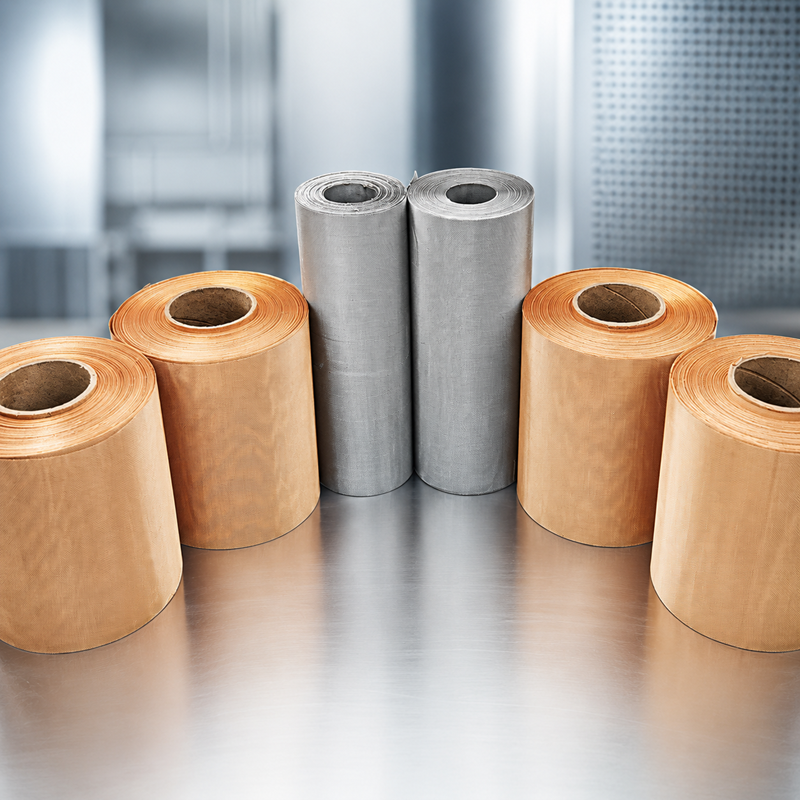
Moretec provides precision metal mesh solutions, including woven mesh rolls, precision-cut mesh components, cryogenic metal mesh, and customized metal-rimmed filter elements for filtration, cryogenic, vacuum, new energy, aerospace, and other advanced industrial applications.
Industrial equipment often operates under conditions where material performance directly affects system reliability and product quality.
Applications involving gases, liquids, polymers, vacuum systems, or cryogenic equipment may require metal mesh materials to maintain dimensional stability and consistent performance over long periods of operation.
Compared with some conventional filtration materials, precision metal mesh provides several advantages:
Stable structure: Precisely controlled mesh openings help maintain consistent performance.
High mechanical strength: Metal materials can withstand vibration, pressure, and demanding operating conditions.
Temperature resistance: Suitable materials can maintain reliable performance in high- or low-temperature environments.
Corrosion resistance: Stainless steel and phosphor bronze are suitable for many demanding industrial conditions.
Long service life: Durable metal structures can reduce replacement frequency.
Reusability: Many metal mesh filter elements can be cleaned and reused depending on the application.
The performance of a metal mesh filter depends not only on the material itself, but also on the mesh structure, opening size, wire diameter, surface condition, and manufacturing precision.
Therefore, the complete operating environment should be evaluated before selecting a metal mesh specification.
Material selection is one of the most important factors when designing a metal mesh component or industrial filtration system.
Moretec mainly provides precision metal mesh products made from stainless steel and phosphor bronze, with specifications selected according to customer requirements and operating conditions.
| Material | Main Characteristics | Typical Applications |
|---|---|---|
| Stainless steel | High corrosion resistance, mechanical strength, heat resistance, and durability | Precision filtration, industrial equipment, high-temperature and demanding environments |
| Phosphor bronze | Good conductivity, thermal performance, flexibility, and corrosion resistance | Cryogenic equipment, MRI systems, precision components, electrical and thermal applications |
Stainless steel is widely used in industrial filtration because of its combination of mechanical strength, corrosion resistance, and temperature capability.
Depending on the application, materials such as SUS304 and SUS316L can be used for precision mesh products.
Typical applications include:
Industrial filtration
Polymer processing
Precision equipment
High-temperature environments
Vacuum-related systems
Industrial fluid control
Phosphor bronze provides a different combination of properties, including:
Good thermal conductivity
Electrical conductivity
Flexibility
Corrosion resistance
Stable mechanical properties
These characteristics make phosphor bronze mesh particularly suitable for certain cryogenic, MRI, thermal, electrical, and precision industrial applications.
Material selection should always be combined with consideration of mesh opening, wire diameter, structural strength, and operating conditions.
Metal mesh can be manufactured and processed into different structures depending on the final application.
Woven metal mesh is one of the most widely used structures because it provides precise mesh openings and good dimensional consistency.
Woven mesh rolls can be supplied in different:
Materials
Mesh counts
Wire diameters
Widths
Dimensions
They can be further processed into precision components for filtration, cryogenic equipment, shielding, and industrial applications.
Different mesh specifications influence:
Filtration accuracy
Flow resistance
Mechanical strength
Open area
Thermal performance
Cleaning capability
For filtration applications, smaller openings generally provide finer particle retention but may increase pressure loss.
For applications requiring higher flow rates, larger openings may reduce flow resistance while maintaining the required filtration performance.
The correct specification therefore requires a balance between filtration accuracy, mechanical strength, and flow performance.
One important application area for precision metal mesh is cryogenic and vacuum equipment.
Cryogenic systems may operate at extremely low temperatures, placing special demands on material stability, thermal performance, and mechanical reliability.
Precision metal mesh can be used in equipment such as:
Cryogenic systems
Cryopumps
MRI-related equipment
Vacuum equipment
Low-temperature engineering systems
In these applications, stainless steel and phosphor bronze mesh can be selected according to the required thermal, mechanical, and structural characteristics.
Phosphor bronze is particularly useful where thermal conductivity and stable low-temperature performance are important.
For cryogenic applications, mesh consistency is also critical. Variations in wire diameter, opening size, or weaving quality can influence system performance.
This is why precision manufacturing and inspection are important when producing metal mesh for advanced low-temperature equipment.
Metal mesh filters are also widely used in industrial processing and polymer filtration.
For applications involving PET, PP, PA, synthetic fibers, lubricants, petrochemical materials, or other viscous fluids, filter elements may need to withstand:
Elevated temperatures
Pressure
Viscous media
Continuous operation
Repeated cleaning
Customized metal-rimmed filter elements can provide good structural stability while maintaining controlled filtration performance.
Depending on the required application, filter specifications can be customized in terms of:
Filtration rating
Mesh structure
Diameter
Outer dimensions
Material
Edge or rim structure
Reusable metal filter structures can also help reduce replacement frequency compared with disposable filtration media in suitable operating conditions.
Selecting a metal mesh filter requires more than simply choosing a mesh count.
Engineers should evaluate several factors together.
The opening size directly affects filtration accuracy and particle retention.
Smaller openings generally provide finer filtration, while larger openings allow higher flow rates.
Wire diameter influences:
Mechanical strength
Mesh stability
Open area
Flow resistance
Durability
A finer wire can increase open area, while a thicker wire generally provides greater structural strength.
Material selection should consider:
Corrosion resistance
Temperature
Thermal conductivity
Mechanical loading
Chemical environment
Electrical properties
The same mesh specification may perform differently under different operating conditions.
Important parameters include:
Temperature
Pressure
Vacuum level
Fluid or gas type
Chemical exposure
Vibration
Flow rate
For precision industrial applications, consistency is critical.
Variations in mesh opening, wire diameter, surface condition, or dimensions may affect system performance.
A reliable supplier should therefore control both the weaving process and subsequent processing operations.
Many industrial applications require more than standard mesh rolls.
Metal mesh may need to be processed into specific shapes and dimensions before installation into equipment.
Moretec supports customized metal mesh processing according to customer drawings and technical requirements.
Available processing capabilities can include:
Precision cutting
Punching
Laser cutting
Strip cutting
Rolling
Heat treatment
Customized dimensions
Customized mesh specifications
This allows woven mesh material to be supplied as finished or semi-finished precision components for different industrial systems.
For OEM equipment manufacturers, customized mesh processing can reduce secondary processing requirements and simplify supply-chain management.
Moretec provides precision metal mesh products for customers requiring stable quality and customized specifications.
Its product range includes:
Woven mesh rolls
Cryogenic metal mesh
Precision-cut mesh components
Metal-rimmed filter elements
Customized industrial mesh parts
Depending on customer requirements, Moretec can support different:
Materials
Mesh counts
Wire diameters
Widths
Dimensions
Processing methods
Moretec's metal mesh solutions are used in applications including:
Precision filtration
Cryogenic engineering
MRI and low-temperature equipment
Vacuum systems
Polymer processing
New energy systems
Aerospace
Industrial equipment
For customers developing precision equipment or filtration systems, choosing the correct mesh specification and processing method can improve product consistency and reduce production risks.
Choosing the right metal mesh filter or precision metal mesh component requires careful evaluation of material, mesh structure, wire diameter, opening size, filtration requirements, and operating environment.
Stainless steel and phosphor bronze each provide different advantages depending on the application.
For filtration systems, the correct mesh specification can improve particle control, flow performance, durability, and service life.
For cryogenic, MRI, vacuum, and precision industrial equipment, manufacturing consistency and material performance are equally important.
Moretec provides customized precision metal mesh solutions, including woven mesh rolls, cryogenic mesh components, and metal-rimmed filter elements, helping customers achieve stable performance through precision manufacturing and technical support.
A metal mesh filter is commonly used for filtration, separation, fluid control, and particle retention. Precision metal mesh can also be used in cryogenic, vacuum, shielding, thermal, and other industrial applications.
Stainless steel and phosphor bronze are commonly used. The correct material depends on corrosion resistance, temperature, mechanical, thermal, and electrical requirements.
Important factors include mesh opening size, wire diameter, material, mesh structure, open area, surface quality, and manufacturing precision.
Yes. Metal mesh can be customized by material, mesh count, wire diameter, width, dimensions, shape, and processing method according to customer requirements.
Many metal mesh filters can be cleaned and reused, depending on the operating environment, filtration medium, and filter structure.
Yes. Properly selected stainless steel and phosphor bronze mesh can be used in cryogenic systems, including cryopumps, MRI-related equipment, and other low-temperature applications.
Precision metal mesh is used in industrial filtration, cryogenic engineering, vacuum equipment, polymer processing, new energy, aerospace, electronics, and advanced industrial manufacturing.