- info@moretec-inc.com
- |
- CN
- |
- JP
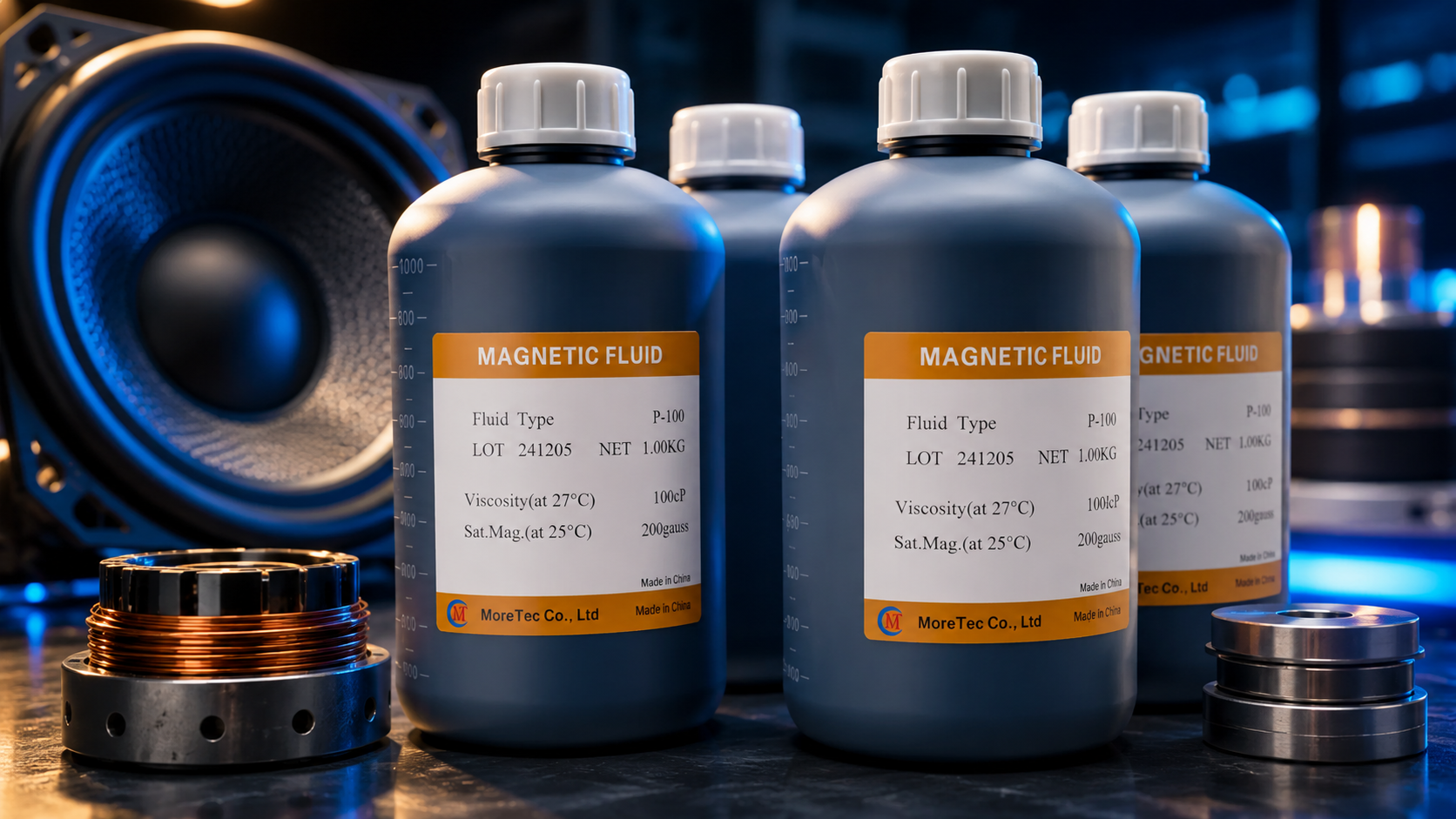
High-performance speakers must maintain stable sound output during continuous operation and high-power conditions. As speaker designs become more compact and powerful, controlling voice coil temperature, damping, and mechanical stability has become increasingly important.
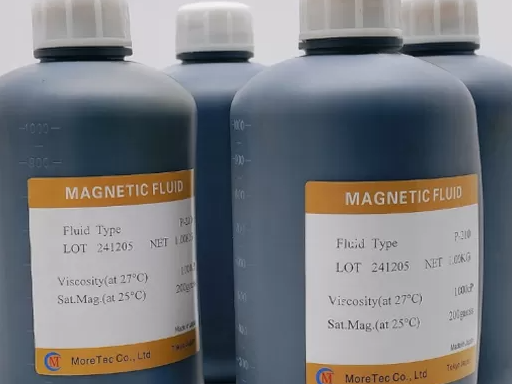
Audio ferrofluid is a magnetic liquid designed for use in the magnetic gap around a speaker voice coil. Held in position by the magnetic field, ferrofluid can improve heat transfer from the voice coil, provide controlled mechanical damping, and help stabilize voice coil movement.
For speaker manufacturers, selecting the correct ferrofluid for speakers requires more than choosing a standard fluid. Viscosity, saturation magnetization, carrier fluid, temperature stability, magnetic gap design, and material compatibility can all influence performance.
Moretec provides standard and customized audio ferrofluid solutions for automotive audio, professional sound systems, Hi-Fi speakers, and other loudspeaker applications.
During speaker operation, electrical current flowing through the voice coil generates heat.
As voice coil temperature increases, electrical resistance also rises. This can influence efficiency, power compression, sound consistency, and long-term component reliability.
Traditional speaker designs dissipate heat through the surrounding air, bobbin, magnet assembly, and other structural components. However, air inside the narrow magnetic gap has relatively limited thermal conductivity.
Introducing ferrofluid into the magnetic gap provides an additional thermal path between the voice coil and surrounding magnetic structure.
At the same time, the fluid's viscosity provides controlled damping, while the magnetic field keeps the ferrofluid positioned within the gap.
The main functions of speaker ferrofluid include:
Improving heat transfer from the voice coil
Providing mechanical damping
Helping stabilize voice coil movement
Reducing excessive resonance
Supporting consistent speaker performance
Improving reliability under demanding operating conditions
The actual effect depends on the ferrofluid formulation and the loudspeaker design.
Voice coil temperature is an important limitation in high-power loudspeaker design.
When the voice coil becomes hot, its resistance increases. This can reduce electrical efficiency and contribute to power compression during extended high-output operation.
Ferrofluid fills part of the air gap between the voice coil and magnetic structure and provides a more effective heat-transfer path.
Heat can therefore move from the voice coil toward the surrounding magnet assembly, where it can be dissipated through the speaker structure.
This can help:
Reduce voice coil temperature rise
Improve thermal stability
Reduce power compression
Support higher operating loads
Reduce thermal stress on adhesives and other components
However, the improvement depends on the driver structure, magnetic gap, ferrofluid quantity, operating power, and thermal design.
Ferrofluid should therefore be considered as part of the complete speaker thermal management system rather than as an independent guarantee of increased power handling.
Audio ferrofluid also influences the mechanical behavior of the moving system.
Because ferrofluid has viscosity, movement of the voice coil through the fluid creates a damping force.
This damping can affect:
Resonance characteristics
Frequency response
Transient behavior
Voice coil movement
Mechanical stability
The amount of damping depends strongly on ferrofluid viscosity.
In general:
Lower-viscosity ferrofluid provides less damping and allows freer voice coil movement.
Higher-viscosity ferrofluid provides greater damping and stronger control of voice coil movement.
Higher viscosity is not automatically better.
Excessive damping may reduce sensitivity or change the intended frequency response, while insufficient damping may not provide the desired acoustic control.
The correct viscosity should therefore be selected according to the driver's mechanical and acoustic characteristics.
Another important function of audio ferrofluid is voice coil stabilization.
Because ferrofluid is attracted to regions of strong magnetic flux, it remains concentrated within the speaker's magnetic gap.
This magnetic retention can create a restoring effect that helps keep the voice coil centered during movement.
Improved centering can help reduce unwanted lateral movement and support more consistent operation.
This is particularly useful in compact or precision drivers where the available magnetic gap is small and accurate voice coil movement is important.
The effectiveness of this function depends on factors including:
Magnetic field strength
Ferrofluid saturation magnetization
Ferrofluid quantity
Gap geometry
Voice coil dimensions
Driver excursion
For this reason, audio ferrofluid should be matched to the specific loudspeaker structure.
Selecting the right ferrofluid for speakers requires evaluating both fluid properties and loudspeaker design.
| Selection Factor | Why It Matters |
|---|---|
| Viscosity | Determines damping characteristics and influences voice coil movement |
| Saturation magnetization | Influences how strongly the fluid is retained in the magnetic gap |
| Carrier fluid | Affects temperature characteristics, volatility, and material compatibility |
| Temperature stability | Helps maintain consistent performance during continuous operation |
| Magnetic gap | Influences required ferrofluid quantity and magnetic retention |
| Voice coil structure | Affects thermal transfer and mechanical interaction |
| Material compatibility | Helps prevent unwanted interaction with adhesives and other components |
| Operating power | Influences temperature and thermal management requirements |
These factors should be considered together rather than independently.
Saturation magnetization is an important parameter when selecting speaker ferrofluid.
The ferrofluid must remain properly positioned in the magnetic gap while the voice coil moves during operation.
A ferrofluid with suitable magnetic properties can be strongly retained by the speaker's magnetic field.
In general, higher saturation magnetization provides stronger magnetic retention and can help reduce the risk of ferrofluid displacement or splashing during demanding operation.
However, the required magnetic strength depends on:
Speaker magnetic circuit
Gap flux density
Voice coil excursion
Operating frequency
Ferrofluid quantity
Driver structure
Selecting the highest magnetic strength is therefore not always necessary.
The formulation should match the actual magnetic circuit and operating conditions.
Audio ferrofluid consists of nanoscale magnetic particles dispersed in a carrier liquid with the help of surfactants.
The carrier liquid influences several important characteristics, including:
Viscosity
Temperature behavior
Evaporation characteristics
Long-term stability
Material compatibility
Different speaker applications may therefore require different carrier-fluid systems.
Moretec provides audio ferrofluid formulations using different carrier-fluid types, including synthetic hydrocarbon and synthetic ester systems.
The appropriate formulation should be selected according to the speaker's temperature range, acoustic requirements, magnetic circuit, and component materials.
Speakers used in automotive, professional, and other demanding applications may experience elevated temperatures for extended periods.
The ferrofluid must maintain suitable viscosity and magnetic stability throughout the expected operating temperature range.
Important characteristics include:
Temperature-dependent viscosity
Thermal stability
Low volatility
Resistance to separation
Long-term magnetic stability
If ferrofluid properties change excessively with temperature, the driver's damping and acoustic characteristics may also change.
Temperature stability is therefore important for maintaining consistent speaker behavior.
Material compatibility is another important consideration that is sometimes overlooked.
Ferrofluid may come into contact with or remain close to:
Voice coil adhesives
Bobbin materials
Coatings
Centering components
Magnet structures
Other polymer materials
An unsuitable fluid formulation could potentially affect adhesives or other materials over long-term use.
For OEM speaker development, compatibility should therefore be evaluated as part of the ferrofluid selection process.
Moretec can support customers in selecting a suitable ferrofluid according to the materials and structure used in the speaker.
Audio ferrofluid can be used in a variety of loudspeaker designs.
Typical applications include:
Vehicle speakers may operate across wide temperature ranges and for extended periods.
Ferrofluid can support thermal management, damping control, and voice coil stability in automotive speaker systems.
Professional loudspeakers and sound reinforcement systems may operate continuously at high output levels.
Efficient heat transfer and stable performance are particularly important in these applications.
High-fidelity speakers require carefully controlled frequency response and mechanical behavior.
Selecting the correct ferrofluid viscosity and magnetic characteristics can help engineers optimize damping and driver performance.
As speaker systems become smaller, thermal management becomes increasingly difficult because less space is available for heat dissipation.
Ferrofluid can provide an additional heat-transfer path directly within the magnetic gap.
Tweeters and other small drivers often have narrow magnetic gaps and lightweight moving systems.
Properly selected audio ferrofluid can provide both thermal management and controlled damping in these applications.
Not every speaker should use the same ferrofluid.
Different drivers may have significantly different:
Magnetic flux density
Gap dimensions
Voice coil diameter
Excursion
Operating frequency
Power level
Thermal environment
Required damping
For this reason, Moretec provides both standard and customized audio ferrofluid formulations.
Depending on the application, properties such as the following can be adjusted or selected:
Viscosity
Saturation magnetization
Carrier fluid type
Temperature characteristics
Damping behavior
Customized selection allows the ferrofluid to be matched more closely to the acoustic and mechanical requirements of the driver.
To recommend a suitable audio ferrofluid, it is useful to provide information about the speaker design and operating requirements.
Typical information includes:
Speaker type
Voice coil diameter
Magnetic gap dimensions
Magnetic flux density
Voice coil excursion
Operating power
Maximum operating temperature
Target frequency range
Required damping characteristics
Current ferrofluid specification, if available
Adhesive and component materials
Required ferrofluid quantity
For replacement applications, information about the existing ferrofluid can also help identify a suitable alternative.
For new speaker development, testing different ferrofluid specifications may be necessary to optimize the final acoustic performance.
Moretec provides specialized audio ferrofluid solutions for speaker manufacturers and audio equipment developers.
Applications include:
Automotive speakers
Professional audio systems
Hi-Fi loudspeakers
Tweeters
Compact speakers
OEM audio products
Other precision acoustic drivers
Moretec supports different viscosity levels, magnetic properties, and carrier-fluid systems and can develop customized formulations according to specific speaker requirements.
By evaluating magnetic circuit design, damping requirements, operating temperature, and material compatibility, Moretec helps customers identify ferrofluid characteristics suitable for their speaker design.
Audio ferrofluid is more than a cooling material.
When properly selected, it can perform three important functions inside a speaker:
thermal management, damping control, and voice coil stabilization.
The correct ferrofluid depends on viscosity, saturation magnetization, carrier fluid, temperature stability, magnetic gap design, and material compatibility.
Because loudspeaker designs vary significantly, the most effective solution should be matched to the specific driver rather than selecting ferrofluid based on a single parameter.
Moretec provides standard and customized ferrofluid solutions for automotive, professional, Hi-Fi, and other audio applications, helping speaker manufacturers optimize thermal, mechanical, and acoustic performance.
Ferrofluid can improve heat transfer from the voice coil, provide mechanical damping, and help stabilize voice coil movement inside the magnetic gap.
It provides an additional heat-transfer path from the voice coil to the surrounding magnetic structure, helping control temperature during demanding operation.
Ferrofluid influences damping, resonance, and voice coil stability. When correctly matched to the speaker design, it can help optimize frequency response and overall acoustic consistency.
Lower viscosity generally provides less damping, while higher viscosity provides stronger damping. The correct value depends on the driver's acoustic and mechanical requirements.
It influences how strongly the ferrofluid is retained within the magnetic gap. The required value depends on the speaker's magnetic circuit and operating conditions.
Audio ferrofluid can be used in automotive speakers, professional audio equipment, Hi-Fi systems, tweeters, compact speakers, and other suitable loudspeaker designs.